Value Added Course
EFFECTIVE LEADERSHIP
AND TEAM DYNAMICS
SOCCA/VAC/040
BCA Sem.-6
Ms. Jheel Barad
Assistant Professor
Silver Oak College of Computer Application
Silver Oak University
Unit- 2
Team Building and Collaboration
• Understanding Team Dynamics and Team Roles (Belbin’s Team Roles)
• Stages of Team Development (Forming, Storming, Norming,
Performing, Adjourning)
• Strategies for Building High-Performing Teams
• Virtual Team Management and Remote Collaboration
• Case Studies: Successful Team Leadership Examples
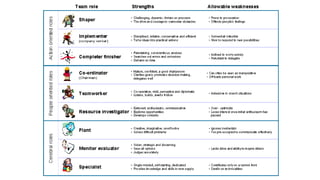
Understanding Team Dynamics and Team Roles (Belbin’s Team
Roles)
Belbin describes a team role as - a tendency to behave, contribute and interrelate with others in a
particular way.
The 9 Team Roles were developed by Dr. Meredith Belbin, a British researcher in management and
team development.
Belbin’s Team Roles theory is based on his study of successful teams at Henley Business School
in the 1970s. He found that teams work best when members take on different, complementary roles.
His model is widely used in business, project management, and leadership training to improve team
performance and collaboration.
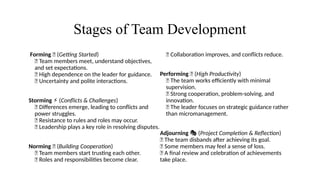
Stages of Team Development
Forming 🤝 (Getting Started)
🔹 Team members meet, understand objectives,
and set expectations.
🔹 High dependence on the leader for guidance.
🔹 Uncertainty and polite interactions.
Storming (
⚡ Conflicts & Challenges)
🔹 Differences emerge, leading to conflicts and
power struggles.
🔹 Resistance to rules and roles may occur.
🔹 Leadership plays a key role in resolving disputes.
Norming ✅ (Building Cooperation)
🔹 Team members start trusting each other.
🔹 Roles and responsibilities become clear.
🔹 Collaboration improves, and conflicts reduce.
Performing 🚀 (High Productivity)
🔹 The team works efficiently with minimal
supervision.
🔹 Strong cooperation, problem-solving, and
innovation.
🔹 The leader focuses on strategic guidance rather
than micromanagement.
Adjourning (
🎭 Project Completion & Reflection)
🔹 The team disbands after achieving its goal.
🔹 Some members may feel a sense of loss.
🔹 A final review and celebration of achievements
take place.
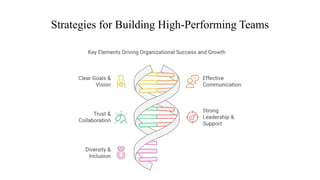
Strategies for Building High-Performing Teams
Virtual Team Management and Remote Collaboration
✅ Virtual Team Management refers to leading, organizing, and coordinating
a team that works remotely, often across different locations and time zones. It
involves using digital tools, setting clear goals, and maintaining productivity
without in-person interactions.
✅ Remote Collaboration is the process of working together virtually using
technology like video conferencing, cloud-based tools, and communication
platforms to complete tasks and achieve shared objectives.
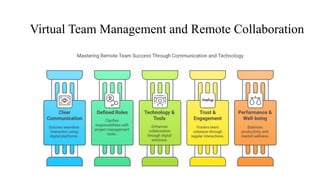
Virtual Team Management and Remote Collaboration
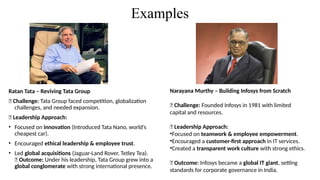
Examples
Ratan Tata – Reviving Tata Group
📌 Challenge: Tata Group faced competition, globalization
challenges, and needed expansion.
📌 Leadership Approach:
• Focused on innovation (Introduced Tata Nano, world’s
cheapest car).
• Encouraged ethical leadership & employee trust.
• Led global acquisitions (Jaguar-Land Rover, Tetley Tea).
📌 Outcome: Under his leadership, Tata Group grew into a
global conglomerate with strong international presence.
Narayana Murthy – Building Infosys from Scratch
📌 Challenge: Founded Infosys in 1981 with limited
capital and resources.
📌 Leadership Approach:
•Focused on teamwork & employee empowerment.
•Encouraged a customer-first approach in IT services.
•Created a transparent work culture with strong ethics.
📌 Outcome: Infosys became a global IT giant, setting
standards for corporate governance in India.

Team Building and Collaboration (Value Added Course Unit-2)

  • 1.
    Value Added Course EFFECTIVELEADERSHIP AND TEAM DYNAMICS SOCCA/VAC/040 BCA Sem.-6 Ms. Jheel Barad Assistant Professor Silver Oak College of Computer Application Silver Oak University
  • 2.
    Unit- 2 Team Buildingand Collaboration • Understanding Team Dynamics and Team Roles (Belbin’s Team Roles) • Stages of Team Development (Forming, Storming, Norming, Performing, Adjourning) • Strategies for Building High-Performing Teams • Virtual Team Management and Remote Collaboration • Case Studies: Successful Team Leadership Examples
  • 3.
    Understanding Team Dynamicsand Team Roles (Belbin’s Team Roles) Belbin describes a team role as - a tendency to behave, contribute and interrelate with others in a particular way. The 9 Team Roles were developed by Dr. Meredith Belbin, a British researcher in management and team development. Belbin’s Team Roles theory is based on his study of successful teams at Henley Business School in the 1970s. He found that teams work best when members take on different, complementary roles. His model is widely used in business, project management, and leadership training to improve team performance and collaboration.
  • 5.
    Stages of TeamDevelopment Forming 🤝 (Getting Started) 🔹 Team members meet, understand objectives, and set expectations. 🔹 High dependence on the leader for guidance. 🔹 Uncertainty and polite interactions. Storming ( ⚡ Conflicts & Challenges) 🔹 Differences emerge, leading to conflicts and power struggles. 🔹 Resistance to rules and roles may occur. 🔹 Leadership plays a key role in resolving disputes. Norming ✅ (Building Cooperation) 🔹 Team members start trusting each other. 🔹 Roles and responsibilities become clear. 🔹 Collaboration improves, and conflicts reduce. Performing 🚀 (High Productivity) 🔹 The team works efficiently with minimal supervision. 🔹 Strong cooperation, problem-solving, and innovation. 🔹 The leader focuses on strategic guidance rather than micromanagement. Adjourning ( 🎭 Project Completion & Reflection) 🔹 The team disbands after achieving its goal. 🔹 Some members may feel a sense of loss. 🔹 A final review and celebration of achievements take place.
  • 6.
    Strategies for BuildingHigh-Performing Teams
  • 7.
    Virtual Team Managementand Remote Collaboration ✅ Virtual Team Management refers to leading, organizing, and coordinating a team that works remotely, often across different locations and time zones. It involves using digital tools, setting clear goals, and maintaining productivity without in-person interactions. ✅ Remote Collaboration is the process of working together virtually using technology like video conferencing, cloud-based tools, and communication platforms to complete tasks and achieve shared objectives.
  • 8.
    Virtual Team Managementand Remote Collaboration
  • 9.
    Examples Ratan Tata –Reviving Tata Group 📌 Challenge: Tata Group faced competition, globalization challenges, and needed expansion. 📌 Leadership Approach: • Focused on innovation (Introduced Tata Nano, world’s cheapest car). • Encouraged ethical leadership & employee trust. • Led global acquisitions (Jaguar-Land Rover, Tetley Tea). 📌 Outcome: Under his leadership, Tata Group grew into a global conglomerate with strong international presence. Narayana Murthy – Building Infosys from Scratch 📌 Challenge: Founded Infosys in 1981 with limited capital and resources. 📌 Leadership Approach: •Focused on teamwork & employee empowerment. •Encouraged a customer-first approach in IT services. •Created a transparent work culture with strong ethics. 📌 Outcome: Infosys became a global IT giant, setting standards for corporate governance in India.